


### Blog Post:
LVP flooring installation is one of the most popular mid-range home upgrades for 2024–2026, but getting pro-quality results means understanding the total installed cost in your region, knowing DIY vs hire triggers, and recognizing the real differences between SPC and LVP before choosing for your basement, kitchen, or high-traffic space.
Key Takeaways
- In 2024–2026, luxury vinyl plank cost per square foot installed typically ranges from $3.50 to $11.00 depending on your region and product.
- DIY LVP flooring installation can save thousands but comes with common pitfall risks—especially with uneven floors, click-lock mistakes, and missed waterproofing steps.
- The single most crucial choice: SPC’s rigid core offers superior dent resistance and stability for kitchens and basements, while standard LVP is softer, easier for DIY, but less forgiving of moisture and heavy use.
- Quick Summary — What this guide gives you
- Regional Installed Cost Breakdown (materials + labor)
- Materials vs Installation — How the total price is built
- Realistic DIY Budget and When DIY Saves Money
- Most Common DIY Failures — What homeowners report
- SPC vs LVP — The technical tradeoffs
- Which to pick by room: basements, kitchens, high-traffic areas
- Waterproof vs Water-Resistant — What labels mean
- How product features affect price (wear layer, rigid-core, thickness)
- Choosing a brand — practical checklist
- Quick DIY checklist and pro-hire triggers
- Sample Budgets and Decision Scenarios
- Common Misleading Claims to Watch For
- FAQ / Decision Flowchart
- Call to Action / Next Steps
Quick Summary — What this guide gives you
This guide breaks down what you can expect to pay for LVP flooring installation in your region, realistic luxury vinyl plank cost per square foot figures, and exactly how to decide between SPC and LVP for your real-world rooms. You’ll see where DIY works, why common mistakes drive up costs, and why SPC’s core is often the better fit for basements and kitchens, while flexible LVP is easier for DIYers but takes more prep in variable spaces. Average installed cost across the US in 2024–2026 is $3.50–$11.00 per square foot.
Regional Installed Cost Breakdown (materials + labor)
Luxury vinyl plank cost per square foot is not fixed. Your region sets the baseline for both material and labor. Below are synthesized price ranges that combine national research and current market data:
- Midwest: $3.50–$7.25 sq ft
- Southeast: $3.75–$7.50 sq ft
- Southwest: $4.00–$7.75 sq ft
- Northeast: $5.00–$9.50 sq ft
- West Coast: $5.75–$11.00 sq ft
Watch for outlier quotes—if a local installer gives you a price outside these ranges, ask for a line-item breakdown or compare multiple bids (source). For a deeper dive into remodeling costs, see home improvement tips.
Materials vs Installation — How the total price is built
Every LVP flooring installation bill is split between materials (flooring planks, underlayment, transition strips), accessories, and turnout labor. Here’s what to expect:
- SPC (Stone Plastic Composite) Material: $3–$6 sq ft
- LVP Material (PVC core): $2–$5 sq ft
- Accessory Materials: $0.25–$1 sq ft (underlayment, trim, stair noses, adhesives if glued)
- Labor (pro install): $1.50–$6 sq ft (region-dependent)
- Total installed cost: $4–$10 sq ft is typical for most homes (source).
Premium boards (extra thick, rigid-core, high embossing, or layered with high-end UV coatings) push the price near $12/sq ft installed, especially on the West Coast and urban Northeast (source).
Realistic DIY Budget and When DIY Saves Money
DIYers eyeing LVP flooring DIY install can save substantially—if they avoid common pitfalls. On a basic 500 sq ft project:
- DIY Material Only (Budget): $2.50–$4 sq ft for entry-grade LVP, $3–$6 sq ft for rigid-core SPC.
- Typical DIY project budget (materials + minimal tools): $1,500–$3,000 for one or two rooms.
- Typical Pro Install: $3,500–$8,000+ (for the same size).
When DIY pays off: Simple, rectangular rooms, concrete slabs in good condition, easy transitions.
When to hire a pro: Wavy or squeaky subfloors, basements with moisture issues, lots of thresholds or patterning, or warranty requirements for pro installation.
For more strategies to save on renovations, review these budget home renovation ideas.
Most Common DIY Failures — What homeowners report
Most first-time LVP flooring DIY install projects encounter at least one of these problems:
- Uneven subfloor (telegraphing): Gaps, visible bumps, or valleys. Avoid by carefully checking subfloor flatness—most products require less than 1/8″ height variation over 6′.
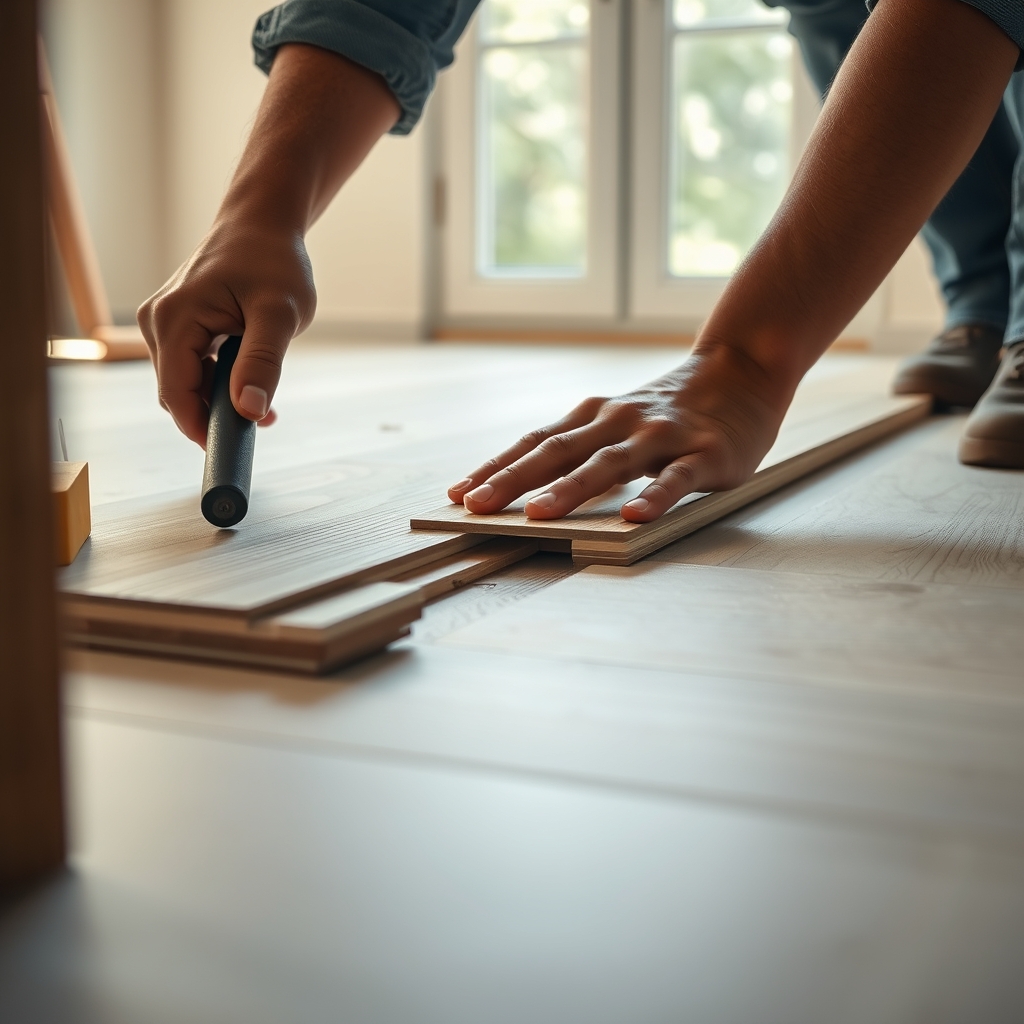
- Mis-aligned click-lock seams: Staggering gaps or boards that don’t sit flush. Lay first row precisely; don’t force planks into place.
- Edge sealing failures: Perimeter leaks under baseboards or at thresholds cause hidden water damage. Always use moisture barriers and caulk edges in wet zones.
- Rigid-core handling struggles: SPC boards are heavy, snap less easily, and require careful handling to avoid seam chipping.
- Damaged wear layer: Dropped tools or dragging heavy furniture scratches the clear topcoat, often instantly voiding the warranty.
- Missed warranty requirements: Many “lifetime” LVP warranties are void if installer skips approved underlayment or doesn’t prep subfloor per spec (source).
No matter how many DIY videos you watch, always read your specific floor’s installation sheet—manufacturers often require photo proof of subfloor moisture readings or caulking.
SPC vs LVP — The technical tradeoffs most competitors gloss over
Forget the marketing claims: SPC and LVP are technically very different, and your choice matters by room.
| SPC (Stone Plastic Composite) | LVP (Flexible Vinyl Core) | |
|---|---|---|
| Core Structure | Stone/polymer composite core, rigid | Flexible PVC core, semi-rigid |
| Stability | Superior dimensional stability, almost no expansion-contraction with temp swings or moisture | Moderate stability, more prone to minor gapping in variable temps/humidity |
| Dent Resistance | Very high—great for playrooms, kitchens, heavy loads | Moderate; indentations possible under furniture/appliance legs |
| Feel & Sound | Harder, often louder underfoot; cold feel unless extra underlayment is used | Softer, warmer, quieter for bare feet |
| DIY Friendliness | Heavy, tougher to cut and click together cleanly, prone to chipping if forced | Easier to cut with knife, clicks together with moderate force, lighter per box |
| Moisture Handling | Excellent core waterproofing; still needs seam and edge protection | Core is water resistant but plank seams require extra sealing in wet areas |
| Price | $3–$6/sq ft (material); $4–$10/sq ft installed | $2–$5/sq ft (material); $4–$10/sq ft installed |
For a more detailed SPC vs LVP flooring breakdown, see this technical comparison and this room-by-room advice.
Which to pick by room: basements, kitchens, high-traffic areas
Here’s how to choose:
- Kitchens, playrooms, areas with lots of dropped objects or rolling chairs: Go SPC. It shrugs off impact, resists dents, and handles fluctuating temperatures (source).
- Basements and concrete slabs: SPC is much less prone to expansion-contraction and is a better barrier for “LVP flooring for basement” scenarios. Always pair with correct underlayment and edge sealing for waterproof LVP flooring performance.
- Living rooms and bedrooms: Standard LVP works if subfloor is flat and dry. Use a quality underlayment for warmth and comfort.
- High-humidity climates or flood-prone rooms: Prefer SPC, or be prepared to take extra seam/protection steps with LVP. “Waterproof LVP flooring” claims do not protect against edge breaches—always check warranty disclaimers.
Waterproof vs Water-Resistant — What the labels mean and why it matters
“Waterproof LVP flooring” is an industry term—individual planks or SPC cores rarely swell from surface spills—but water can still get underneath through seams, cut edges, or notched thresholds. Real-world waterproofing depends on:
- Seam tightness (click-lock vs loose-lay vs glue-down)
- Perimeter and threshold sealing (caulk or foam tape for transitions)
- Underlayment type—some block moisture better than others
Manufacturer warranties on LVP flooring installation typically exclude coverage for moisture damage at the edges if edge sealing isn’t performed. If in doubt, ask your seller: “Does your waterproof warranty still apply if water seeps under the baseboards or thresholds?”
How product features affect price (wear layer, rigid-core, thickness)
Material price changes fast with a few key features:
- Wear Layer: 12-20 mil is standard for mid-grade; 6-8 mil on cheapest LVP. Thicker is better for high-traffic homes.
- Core Type: SPC or WPC (wood-plastic composite) cost more, starting at $4–$6/sq ft material. Flexible core is cheaper.
- Embossed textures & UV coats: More realism and durability, but extra cost.
- Total price bands: Budget LVP $1.50–$2.25/sq ft; mid-range $3–$6/sq ft; premium/rigid-core $6–$12+/sq ft (source).
Want to compare the value of LVP vs hardwood flooring or tile? Explore other affordable renovation options.
Choosing a brand — practical checklist for “best LVP flooring brand 2026”
Instead of hyped top-10 lists, use this checklist to pick a reliable LVP brand in 2026:
- Warranty: Read the fine print—does it require pro installation, specific underlayment, edge sealing, or exclusions for kitchens/basements?
- Wear Layer/Specs: Confirm stated wear layer in mil or mm. (Ask: “What’s the actual mil thickness and composition of the wear layer?”)
- Sample review: Order samples and lay them in your target room—check color in natural light and “feel” underfoot.
- Return/support: What is the retailer’s return window and process for planks damaged in shipment?
- Price-performance: Use the cost buckets: budget $1.50–$2.25/sq ft, mid $3–$6, premium (SPC or thick wear layer) $6–$12+. Don’t overpay for hype. Get at least two written quotes.
Copy and paste these questions for any supplier:
- “Is pro installation required for full warranty?”
- “Does your waterproof warranty cover flooded edges or only plank surfaces?”
- “May I see independent lab results on wear-layer thickness?”
Quick DIY checklist and pro-hire triggers
Before you buy a single box, walk through this:
- Subfloor flatness: No more than 1/8″ height change over 6′. Fill dips, sand humps.
- Moisture test: Especially for basements — tape a 2×2′ plastic sheet down for 48 hours. If you see drops, test further before LVP flooring installation.
- Underlayment: Match your floor’s requirements; some LVP has attached pad, others require roll underlayment.
- Tools: Utility knife, tapping block, pull bar, spacers, straight edge, moisture meter.
When to hire a pro: If subfloor repair, hidden structural issues, or complex layouts are on the table. Subfloor prep costs can add $2–$15/sq ft if under-estimated, often outpacing the DIY savings.
Already handy? See DIY home improvement for beginners for more detailed project guides.
Sample Budgets and Decision Scenarios (3 quick case studies)
Here’s how real homeowner budgets break down:
- Small bedroom, Midwest, DIY flexible LVP: 150 sq ft x $2.50 (material) = $375. Add $90 underlayment, $60 transitions/trims. Total: $525.
- Whole-floor pro install, Midwest, mid-grade SPC: 1,000 sq ft x $6 (installed) = $6,000 all-in. Watch for subfloor prep add-ons ($500–$1,000 typical).
- Basement, West Coast, SPC, pro install: 400 sq ft x $8.00 (installed) = $3,200 plus $300–$800 for quality vapor barrier and edge sealing. Total: $3,500–$4,000.
Realistic DIY projects often cost $1,500–$3,000, pro installs across regions range $3,500–$8,000+ (source).
Common Misleading Claims to Watch For (competitor marketing traps)
Watch for these classic red-flag claims:
- “100% waterproof” by itself: Always ask: “What about seepage under baseboards or at seams?” Most products do not cover edge leaks.
- “Commercial grade/residential lifetime warranty”: Ask for the wear-layer thickness (12 mil minimum for busy homes).
- Warranty only applies when pro installed: If DIY, always clarify what proof is required for a claim.
Remember, LVP vs hardwood flooring often comes down to expectations. Ask tough questions and always get details about installation-sensitive vulnerabilities before committing. For more on maximizing your investment in upgrades, explore how to increase home value.
Short FAQ / Decision Flowchart
What is the average luxury vinyl plank cost per square foot installed in 2024–2026?
National average for LVP flooring installation is $3.50–$11.00 per square foot (material + labor included, varies by region).
How should I choose between SPC vs LVP flooring?
Pick SPC if you want durability and stability for kitchens, basements, or shifting/unconditioned rooms. Choose flexible LVP for warmer, quieter floors in bedrooms or living spaces—only if your subfloor is flat and dry.
Is LVP flooring DIY install really doable for a homeowner?
Yes for basic rooms if you’re detail-oriented and have a level subfloor. For complex layouts, moisture issues, or multiple thresholds, a pro is often worth it.
What is the best approach to LVP flooring for a basement?
Always use SPC over a quality vapor barrier. Carefully seal all edges and seams, check the moisture specs, and document prep for warranty.
What are typical causes of DIY failures?
Uneven subfloor (telegraphing gaps), click-lock seam issues, missed edge sealing, handling damage on rigid boards, and missed steps that void warranties.
Call to Action / Next Steps
Ready to move forward? Here’s what to do next for a smart LVP flooring installation:
- Use the regional cost ranges as a reality check; collect 2–3 local, written quotes and compare.
- Walk your space with the DIY checklist above before ordering materials.
- Always request and review warranty documentation and install guides before spending a dollar.
Spot an outlier quote? Midwest should fall between $3.50–$7.25/sq ft, West Coast between $5.75–$11.00/sq ft—don’t be afraid to negotiate. For more step-by-step visuals, bookmark best home improvement tips. LVP flooring installation can dramatically lift your home’s style and function—just make sure you understand what you’re really paying for.